



%201.svg)

Why the Xiaomi YU7 is a bigger story than one new SUV
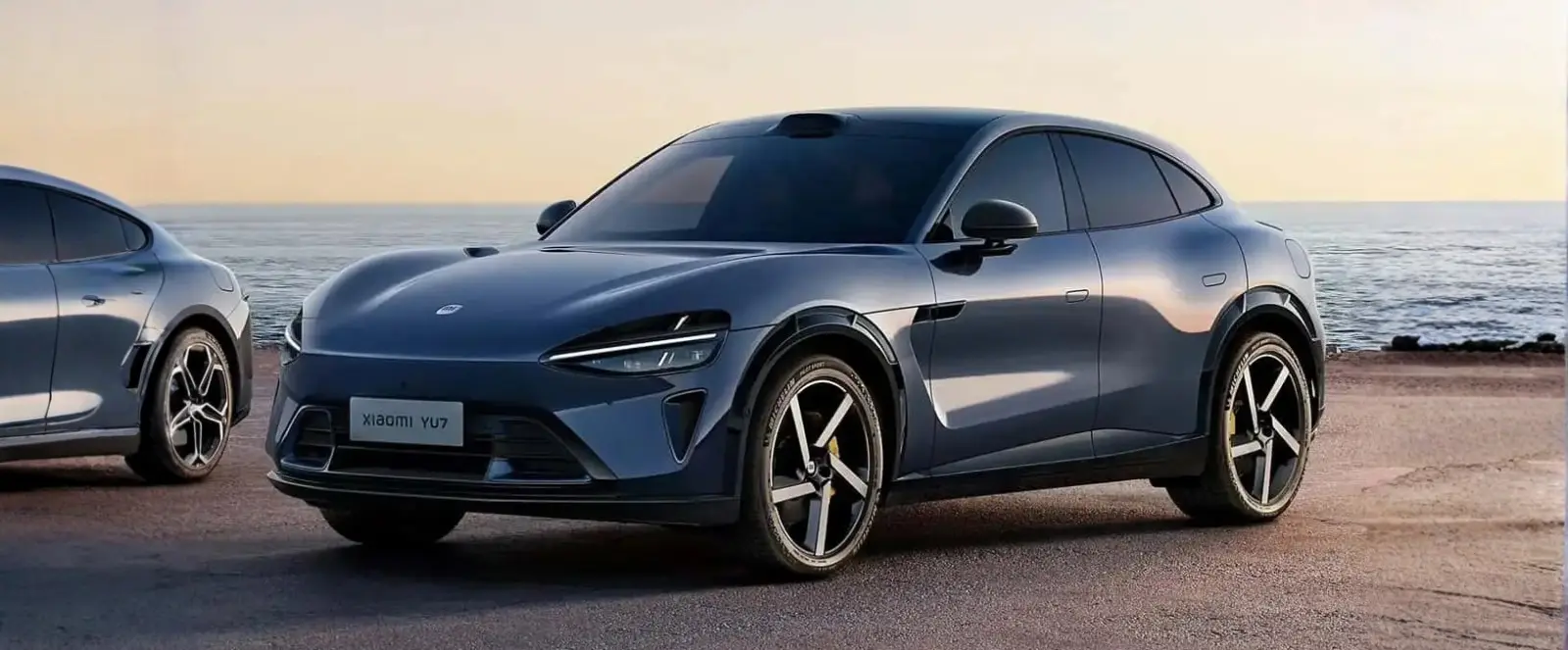
The Xiaomi YU7 is not just another electric SUV launch. It is a signal that the “China execution speed” playbook is now fully aimed at cars.
Xiaomi officially launched the YU7 on June 26, 2025, starting at 253,500 yuan, with three trims: Standard, Pro, and Max. That pricing and positioning is aimed straight at the Tesla Model Y segment in China, and the early demand numbers reported by Chinese EV media were huge.
On paper, the YU7 reads like a checklist of what buyers keep asking for:
- long claimed range
- fast charging on an 800V platform
- high performance in the top trim
- a tech ecosystem that feels familiar if you already live on Xiaomi devices
But here’s the thing. Cars are not phones. People do not replace them every year. Cars have wear, heat cycles, suspension loads, braking loads, and long-term servicing realities that do not care about launch hype.
So this blog is a Discussion and Debate, in plain language:
- Side A: China’s speed and affordability
- Side B: quality, wear-and-tear, parts, and what happens in year 3, 5, or 8
And we will use the Xiaomi YU7 as the case study.
The Xiaomi YU7 in simple numbers (and what those numbers do and do not mean)
Let’s start with the facts that matter, without pretending a spec sheet is the whole truth.
Core specs people will compare
Xiaomi’s own global write-up and multiple EV publications describe the YU7 Standard with a claimed 835 km CLTC range, and the platform as 800V silicon carbide with very fast charging claims.
Reported highlights include:
- Claimed range up to 835 km (CLTC) on the Standard trim
- Drag coefficient Cd 0.245, after 40+ aero refinement zones (Xiaomi’s claim)
- 800V silicon carbide platform across versions, with a claimed 10 to 80% in as little as 12 minutes, and “up to 620 km in 15 minutes” (CLTC context)
- Top trim performance reported at 0 to 100 km/h in 3.23 seconds and 253 km/h top speed
The catch with range and charging claims
Most of the world is trained on EPA or WLTP thinking. China uses CLTC, and those numbers often look higher.
A simple way to think about it is this: CLTC is typically more “low speed friendly,” so it can produce more optimistic range numbers than EPA style testing.
Also, fast charging claims depend on:
- charger power and stability
- battery temperature
- whether the car can precondition the battery
- how full the pack already is
Even when an 800V platform is real, the charging curve still matters more than the headline. Xiaomi’s own page references “as little as 12 minutes” for 10 to 80%, which is best-case language.
Independent highway range testing reported by autoevolution showed a YU7 result closer to roughly 500 km in a highway test, far below a 750 km CLTC claim for that tested configuration, while charging performance impressed.
So yes, the YU7 can be genuinely strong. But if you are shopping in the UAE, you should treat CLTC range as a starting point, not a promise.
“TikTok execution” applied to cars: what people mean, and what they miss
When someone says China is doing a “TikTok execution race” in cars, they usually mean:
- move fast
- learn fast
- ship faster than legacy competitors
- win by combining good-enough hardware with great distribution and software
That model worked in social platforms because software can scale instantly. Cars are different because hardware fails in slow motion. A suspension bushing does not break on day 1. A battery cooling pump might not show weakness until years of heat cycles.
Still, there are reasons this strategy is landing:
- China’s EV market is massive, which accelerates learning loops. The IEA reported China represented about 60% of global electric car sales in 2023.
- New brands are building around software from day one.
- Pricing pressure is real. CnEVPost reported YU7 starting price undercutting the Model Y in China at launch.
What this means is… legacy brands now have to compete against companies that iterate like consumer tech, not like old auto.
But the debate is not settled, because the “long run” is not a marketing line. It is a 5 to 10 year reality.
Speed and affordability: the strongest case for the Xiaomi YU7
Let’s be fair. If you want the best argument for why the Xiaomi YU7 matters, it looks like this.
1) Performance is no longer exclusive
A 0 to 100 km/h time around 3.23 seconds (for the top trim) is supercar territory from a decade ago.
People will compare that to luxury benchmarks even if the price segment is different, because humans compare feelings, not categories.
2) Charging is becoming a brand weapon
Xiaomi claims an 800V silicon carbide platform, with best-case 10 to 80% in 12 minutes and up to 620 km in 15 minutes (CLTC context).
Even if real life is slower, this is still a statement. Charging time is the new “engine sound” in EV buying. It shapes confidence.
Also, an onsemi press release later highlighted that select YU7 models feature an advanced 800V drive platform powered by onsemi silicon carbide technology, which supports the idea that this is not just a brochure claim.
3) Aero and efficiency are being treated seriously
Cd 0.245 is an unusually low drag claim for an SUV, and Xiaomi ties it directly to range improvement.
Whether you love the brand or not, this shows engineering attention in the places that actually matter for EV range: aero, rolling resistance, and thermal management.
4) Tech ecosystem is a real advantage
Wired described the YU7 as packed with Xiaomi ecosystem integration, including display tech and cabin features that feel like consumer electronics thinking.
This matters because a lot of buyers now expect the car to behave like a smart device.
So yes. There is a strong case that China can deliver speed and features per dirham in a way that legacy brands struggle to match.
Quality and wear-and-tear: the strongest case against “fast wins”
Now the other side.
If you are buying a car to keep, durability is not a vibe. It is data, parts, and service.
1) Long-term reliability data does not exist yet
The YU7 is new. Even if the SU7 sedan gave Xiaomi early experience, a new SUV platform and new production scale can still introduce new failure patterns.
Real reliability is not proven in reviews. It is proven in:
- how it ages in heat
- how it handles repeated fast charging
- how software updates behave over years
- how easy it is to repair after small accidents
2) Fast charging is not “free”
Fast charging is great. It is also harder on batteries and cooling systems than slow charging, especially in hot climates. The car must manage heat and charging current correctly over time.
There is ongoing research showing extreme heat increases strain on battery thermal stability and can accelerate degradation if not managed well.
In the UAE, where summer temperatures can be brutal, this matters.
3) Software is a new type of risk
Software updates can improve range prediction, charging curves, and driver assist. They can also introduce bugs.
This is not anti-China. This is true for everyone. But a company coming from phones may be tempted to treat cars like yearly product cycles.
Here’s how it works in real ownership:
- you want updates that are transparent
- you want stable feature behavior
- you want clear rollback and support if something breaks
4) Parts availability decides real-world happiness
Even premium brands can be slow with parts, but newer brands can be worse because:
- fewer independent repair channels
- fewer stocked parts locally
- less known repair workflows for body panels, sensors, and high-voltage components
If you plan to keep the car for years, the “parts pipeline” matters as much as the battery.
The warranty question: what good warranty looks like, and what marketing warranty looks like
Warranties are where this debate becomes real, because warranty tells you what the brand is willing to stand behind.
What to look for in EV warranty terms
A practical EV warranty is not just “8 years battery.”
You want clarity on:
- minimum battery capacity retention (some brands state 70% as a floor)
- what counts as “defect” vs “normal degradation”
- exclusions around charging habits, track use, abuse, and modifications
- whether cooling system components are covered the same way as battery modules
- whether software faults are treated as warranty issues
Tesla is one example of a major brand that states a minimum 70% capacity retention over its battery warranty period (details vary by model).
BYD’s EU announcement around Blade Battery coverage is another example of explicit battery warranty positioning, stating 8 years and extending mileage to 250,000 km with a 70% minimum state of health, for Europe.
Zeekr markets “up to 10 years warranty” in Europe when owners follow the recommended service schedule, with terms and conditions.
Important: these examples are region-specific. You should never assume the same terms apply in the UAE unless you have the UAE warranty booklet for that exact model and distributor.
Where EV warranty debates usually go wrong
People often confuse:
- “warranty length” with “warranty usefulness”
- “battery warranty” with “full car warranty”
- “marketing headline” with “what gets approved when you file a claim”
The catch is that wear-and-tear items are typically excluded in most warranties. That means the most common costs in years 3 to 7 can be on you unless you plan for it.
This can help if you are thinking long-term: consider an extended warranty plan that clearly defines coverage for high-value EV components and common failure points. If you are exploring that route, coordinate with a specialist extended warranty provider that understands EV parts and repair workflows.
A simple framework to judge the Xiaomi YU7 (and any fast new EV brand)
If you want a clean way to decide without getting pulled by hype or fear, use this.
The 4-part Ownership Reality Score
Score each item from 1 to 5.
- Warranty clarity
Do the documents clearly state what is covered, for how long, and with what battery health thresholds? - Parts and service readiness
Can you get high-voltage diagnostics, body parts, sensors, and cooling parts in your region with predictable lead times? - Software transparency
Are updates documented, stable, and supported with clear service escalation? - Resale depth
If you sell in 2 to 3 years, is there a buyer pool that trusts the brand?
Add your scores. Then compare it to a safer baseline like a Tesla, a mature Chinese EV brand, or a legacy manufacturer with local support.
What this means is… you stop arguing about “China vs Europe” and start judging ownership risk.
Checklist: if you are considering the Xiaomi YU7 in the UAE or GCC
Keep this short. Save it. Use it.
- Ask for the official warranty booklet for your region, not a sales slide
- Confirm battery warranty includes a stated minimum capacity retention figure
- Ask what happens if a sensor or camera fails after an update
- Confirm fast charging compatibility with local networks and whether the car preconditions the battery
- Ask about parts lead time for bumpers, headlights, and sensors
- Get an insurance quote in writing, because new models can surprise you
- Plan your charging habits: daily slow charging plus occasional fast charging is usually healthier than constant fast charging
- Do a battery health check process: baseline now, then recheck every 6 to 12 months
If you only do one thing, do this: treat warranty and parts readiness as equal to performance.
Common mistakes people make in this debate
1) Believing the best-case charging time will be your daily experience
Fast charging claims are often achieved under ideal conditions. Xiaomi’s “as little as 12 minutes” wording is a clue that it is best-case.
2) Treating CLTC range as real highway range
Independent testing suggests real highway range can land far below CLTC in some cases.
3) Assuming “software brand” automatically means better car software
Consumer tech companies can be great at UI and ecosystems. Vehicle safety and stability is a different domain. The proof is in how updates behave over time.
4) Ignoring the boring stuff
Alignment, tires, suspension bushings, brakes, and cabin rattles decide how the car feels after 30,000 km, not 0 to 100 times.
5) Assuming resale will follow specs
Resale follows trust, parts supply, and community demand more than horsepower.
A short real-world scenario: two buyers, two different “wins”
Ahmed in Dubai wants an electric SUV that feels new, fast, and tech-first. He is excited by the Xiaomi YU7 because the numbers look unreal for the price class.
His friend Sameer is also interested, but he asks different questions:
- who services the high-voltage system locally?
- how long do body parts take after a minor accident?
- what does the warranty actually exclude?
- what will the battery health look like after three UAE summers?
Ahmed realizes something. He is not deciding whether the YU7 is fast. He is deciding whether he is comfortable being early.
Being early can be fun. It can also be expensive if the support system is not ready.
Neither buyer is “right.” They just value different wins:
- Ahmed values speed and features per dirham.
- Sameer values low surprise costs.
Where the Ferrari Purosangue comparison fits (and where it does not)
People will bring up cars like the Ferrari Purosangue in these conversations, usually to prove a point about prestige.
It is not a direct competitor. The value proposition is different.
But it is a useful contrast for one reason: it shows what luxury buyers still pay for.
Ferrari positions the Purosangue with 0 to 100 km/h in 3.3 seconds and 0 to 200 in 10.6 seconds, plus the emotional “V12 experience.”
So here is the clean comparison line:
- The YU7 is chasing speed-per-money and software-led convenience.
- Purosangue is selling status, heritage, and a decades-long brand story.
If you buy luxury, you are often buying the story as much as the machine.
FAQ
Is the Xiaomi YU7 officially available in the UAE?
Availability depends on official distributor launches and homologation. The YU7 launched in China in June 2025 and was positioned as a Tesla Model Y rival there. For UAE availability, always verify local official channels.
Is the 835 km range real?
It is a CLTC rating claim for the Standard trim. Real-world highway range can be significantly lower, and at least one independent test reported roughly 500 km on a highway-style test for a YU7 configuration, which was well below a CLTC figure.
Does 800V mean it will always charge extremely fast?
Not always. Xiaomi claims an 800V silicon carbide platform and best-case fast charging figures, but your results will depend on charger power, battery temperature, and charging curve behavior.
Are Chinese EV warranties really longer than everyone else?
Sometimes, in specific regions. BYD announced an 8 year Blade Battery warranty in Europe with mileage extended to 250,000 km and a 70% minimum SOH. Zeekr markets “up to 10 years warranty” in Europe with service schedule conditions. Always check the exact region and model terms.
Will cars become like smartphones, replaced every year?
Unlikely. Cars face safety regulations, depreciation realities, and long ownership cycles. What will change faster is software and model refresh cadence. The smarter move is to plan for long-term support, not annual replacement.