



.webp)
%201.svg)

EV and petrol repair guide for car owners in the UAE today
Many drivers in the UAE are familiar with petrol car maintenance. Oil changes, spark plugs and exhaust repairs are part of normal ownership. When they switch to an electric vehicle, a common question appears: what actually changes in the workshop?
Some systems disappear completely, some remain almost identical and some become more specialised. Knowing this helps you set the right expectations and choose a workshop that is prepared for modern EVs.
1. What disappears when you move from petrol to EV
The clearest difference between a petrol car and an EV is the absence of a combustion engine. Along with it, a long list of related systems also disappears:
- Engine oil and oil filters
- Spark plugs and ignition coils
- Fuel pumps, filters and injectors
- Engine timing belts or chains
- Exhaust system and catalytic converter
- Many emission control components
These items are the source of a lot of routine work on petrol cars. Removing them means fewer fluids to replace, fewer moving parts to wear out and less chance of leaks. Over the life of the vehicle, it can mean lower scheduled maintenance costs compared with a similar petrol model, especially when you drive a lot.
For owners, this often shows up as fewer visits to the workshop and fewer “urgent” dashboard warnings related to engine performance.
2. What stays almost the same
Even though EVs are different under the bonnet, they share many components with petrol cars. These do not disappear and they still need service:
- Tyres and wheel alignment
- Suspension, springs and dampers
- Steering components
- Brake discs, pads and hydraulic system
- Bodywork, glass and interior trim
- Air conditioning hardware and cabin filters
An EV is heavier than a similar petrol car because of the battery pack. This means tyres and suspension carry more load. In UAE driving conditions, with high speeds and strong heat, tyres, brakes and suspension deserve at least as much attention as before.
The difference is that a workshop now looks at these parts in combination with high voltage systems rather than as isolated issues.
3. What becomes more specialised on an EV
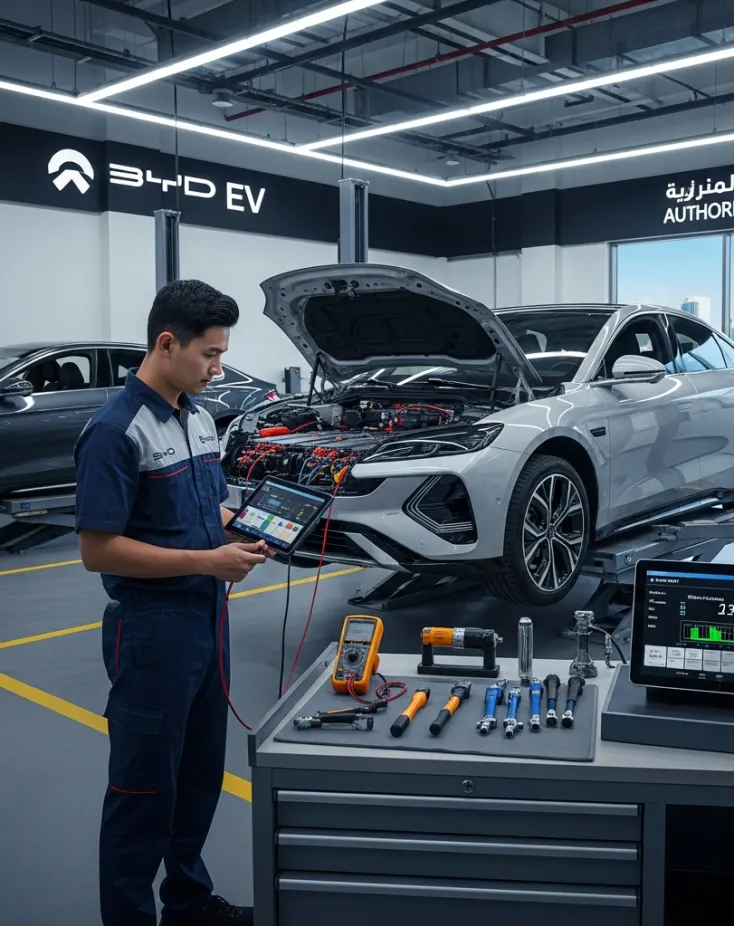
The systems that truly change repair work are centred around the high voltage battery and power electronics. These require knowledge, tools and safety procedures that many traditional workshops are still building.
High voltage battery and power electronics
The high voltage battery operates at several hundred volts. It feeds the inverter, which powers the electric motor, and often the onboard charger.
When a workshop works on these systems, they need to:
- Safely isolate the high voltage system
- Confirm that no high voltage is present in exposed areas
- Use insulated tools and protective equipment
- Understand the correct procedure to re-energise the system
Diagnostics also change. Instead of measuring compression or fuel pressure, technicians review battery state of health, cell balance, temperature data and charging records. A basic scan tool is often not enough. Brand-specific software and log access become more important.
Regenerative braking and hydraulic braking
EVs combine regenerative braking with conventional hydraulic brakes. When you lift off the accelerator, the motor acts as a generator and slows the car. Friction brakes still provide final stopping power and are essential in emergencies.
In practice this means:
- Brake pads can last longer, but they must still be inspected
- Brake fluid still ages and must be replaced on schedule
- Calibration between regenerative and friction braking must be correct
If a workshop does not understand this balance, they might misread normal pad wear or overlook fluid age because the car “feels fine”.
Software and control systems
Software touches almost every part of the car:
- Battery and charging behaviour
- Motor power delivery
- Air conditioning and thermal management
- Driver assistance and safety systems
Repairs often involve software updates or module calibrations rather than simply swapping parts. A workshop that cannot access software tools may be forced to guess, which is not ideal for complex EVs.
4. Typical repair costs – what shifts up and what shifts down
It helps to think in categories.
Areas where EVs often cost less over time:
- No oil changes
- No exhaust repairs
- Fewer engine related breakdowns
- Brake pads that can last longer due to regeneration
Areas that can be more expensive if things go wrong:
- Out-of-warranty battery replacement
- Inverter or onboard charger failure
- Complex driver assistance system repairs
- High voltage wiring issues after accidents
Routine maintenance is usually cheaper or similar. Rare high voltage failures can be expensive. This is one reason why choosing a workshop that understands preventative care is important. Early attention to cooling issues or warning codes can protect you from larger repairs later.
5. Your checklist for EV-ready workshops in the UAE
When you look for a place to service your electric car in the UAE, it helps to ask a few specific questions:
- How many EVs do you work on each month?
- Are your technicians trained for high voltage systems?
- Which brands and models does your diagnostic equipment support?
- Do you follow a written procedure to isolate the high voltage system?
- Can you provide written reports of battery health and fault codes?
Clear answers suggest the workshop has real experience rather than just occasional exposure to EVs.
It is also sensible to ask whether they can service mainstream petrol cars if you have more than one vehicle in the household. Many drivers in Abu Dhabi and Dubai run a mix of EV and petrol, and prefer one service partner.
6. How your behaviour as an owner still matters
No repair guide is complete without owner habits. The way you use the car affects maintenance needs in both petrol and EV worlds.
With an EV:
- Aggressive acceleration and heavy loads increase tyre wear
- Frequent short trips in high heat can test cooling systems
- Repeated fast charging on very hot days can stress the battery
- Ignoring small warnings can lead to larger faults later
With a petrol car:
- Missed oil changes can cause engine wear
- Overheating can damage gaskets and head components
- Poor fuel quality can affect injectors and emission systems
In both cases, paying attention to unusual noises, messages or smells and acting early is often the difference between a simple fix and a major repair.
7. Bringing it together – making a realistic service plan
Rather than thinking of EVs as “maintenance free”, it is more accurate to say that maintenance changes shape.
For petrol cars in the UAE, your focus is on oil, cooling, fuel and exhaust. For EVs, your focus moves towards tyres, brakes, cooling, software and battery management.
If you:
- Follow the schedule in your owner’s manual
- Adapt it slightly to UAE conditions
- Choose a workshop that understands both petrol and EV systems
you will have a practical, manageable repair plan for the years ahead.
.webp)