



%201.svg)

If you’ve ever tried to sell an EV, you’ve seen the same question pop up again and again:
“Is the battery still good?”
That question will only get louder in the UAE as more EVs hit the road, and more of them enter the used market.
So the news that the UAE is moving toward a large-scale, local EV battery recycling and second-life facility matters, not just for the environment, but for regular owners who care about resale value, downtime, and long-term costs.
Let’s break down what’s happening, how battery recycling actually works, and what it changes for you as an EV owner in the UAE.
What’s new in 2026, in plain terms
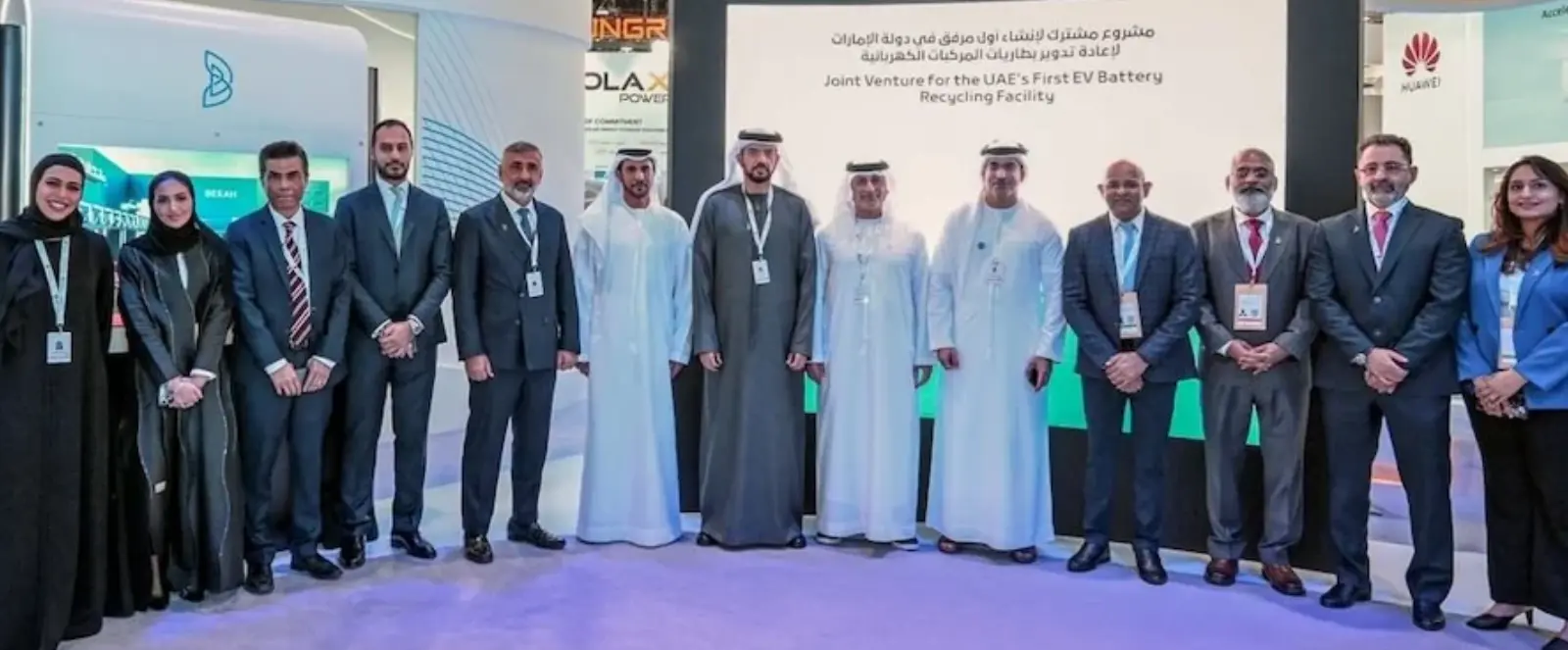
In January 2026, the UAE’s Ministry of Energy and Infrastructure (MoEI), BEEAH, and LOHUM announced plans to form a joint venture to build what’s described as the UAE’s first large-scale facility for EV battery recycling and second-life repurposing.
Key details that matter:
- The facility is planned for BEEAH’s integrated Waste Management Complex in Al Saja’a, Sharjah.
- The target is to process about 1,500 tonnes of lithium-ion batteries in 2026, then double capacity within three years of operation.
- BEEAH has said the hub is expected to become operational this year, and it’s positioned as a national solution for end-of-life EV batteries.
- The facility is expected to include “second-life” use first, then recycling, with tracking and traceability.
Here’s the thing: owners don’t wake up excited about “tonnes processed.” They care about what this changes in real life.
So let’s talk about that.
Why recycling changes resale value more than people think
Most resale anxiety around EVs is not about the motor.
It’s not about the gearbox (there isn’t one in the normal sense).
It’s the battery.
And it’s understandable. A battery pack is the single most expensive part of many EVs. Even when the battery is fine, buyers worry about what happens if it isn’t.
A local, scalable battery recycling and second-life pathway does not magically increase your resale price tomorrow. But it can change the market in three practical ways.
1) It reduces the “what happens if it fails?” fear
When buyers imagine a battery issue, they often imagine only two outcomes:
- the car becomes scrap
- the battery replacement bill is painful
A local recycling and repurposing system creates a third mental picture: there’s an end-to-end pathway for the battery, and the market has infrastructure to handle it.
That doesn’t mean repairs become cheap overnight. But the fear becomes less vague.
And vague fear is what crushes resale values.
2) It pushes the used market toward battery health proof
This is already happening globally. One big signal: Arval (a major leasing company) announced it was offering battery health certificates systematically when reselling used EVs, based on analysis of thousands of vehicles.
When battery health certificates become normal, resale gets more rational.
Instead of:
“I heard EV batteries die fast.”
It becomes:
“This car is at 92% state of health, here’s the report.”
That shift helps good cars hold value better. It also punishes neglected cars more. Which is fair.
3) It creates a stronger second-hand story for the UAE specifically
In the UAE, people keep cars in mixed conditions:
- short city trips
- long highway drives at high speed
- heavy A/C use
- summer heat that doesn’t forgive sloppy thermal systems
So buyers will ask for more proof, not less.
A battery recycling and second-life facility, especially one that talks about traceability from collection to processing, supports a more mature ecosystem where documentation matters.
Quick myth check: most EV batteries are not “dying” in 3 to 5 years
It’s popular to believe EV batteries degrade fast. Real-world data keeps pushing back on that.
A Swedish used-car marketplace (Kvdbil) tested the battery state of health of over 1,300 used plug-in vehicles and found that around 8 out of 10 retained over 90% of original capacity.
Arval’s analysis of 8,300 battery health certificates (across many brands and countries) found an average state of health around 93%, with most vehicles above 80%.
What this means is… battery degradation is real, but it’s usually not the disaster people imagine.
And that’s why battery recycling matters so much: it’s the backstop for the smaller group of packs that do reach end-of-life, get damaged, or become uneconomical to keep in a car.
“Second-life” batteries: what it is and why the UAE cares
Second-life means a battery that is no longer great for a car can still be useful somewhere else.
A simple way to think about it is this:
- An EV battery might feel “tired” in a car when it can’t deliver strong range and power reliably.
- But the same battery might still work fine as stationary storage, where size and weight matter less.
That’s why this UAE project includes second-life repurposing, not just shredding and recycling.
There’s real research behind this idea. NREL (a major US energy lab) has published work on EV battery life cycle management and second-life suitability, including how these pathways can reduce pressure on supply chains.
And a 2025 ACEEE policy brief lays out the benefits and challenges of repurposing EV batteries for stationary storage, including the practical hurdles that stop it from being automatic.
So yes, second-life helps, but it comes with rules.
The catch is not every used EV battery is a good second-life battery
Second-life only works if the battery is:
- stable
- tested properly
- packaged safely
- matched to the right use case
That’s why NREL talks about procedures for assessing suitability, not just “throw it into storage and it’ll be fine.”
If you’re an owner, this matters because it changes how the market might value old packs later.
A pack that’s cared for and well-documented is more likely to be repurposed safely. A pack that’s overheated, abused, or damaged may go straight to recycling, or be rejected from both.
How EV battery recycling actually works
People picture a battery going into a machine and coming out as “new battery materials.”
That’s directionally true, but the steps matter.
Here’s how it works in a more real-world way.
Step 1: Collection and safe handling
EV batteries are high-voltage. Even when “dead,” they can still be dangerous. Transport and handling have strict processes.
The UAE project also talks about end-to-end traceability, meaning batteries are tracked from collection and tagging through processing.
Step 2: Discharge and dismantling
Before recycling, packs are typically discharged and dismantled into modules or cells. This isn’t like recycling a phone battery. An EV pack is heavy, complex, and full of sensors, coolant lines, and structural protection.
Step 3: Recycling method (the “wet” approach)
BEEAH has said it plans to use “wet” recycling technology, chosen for safety and higher-quality material recovery. In many contexts, “wet” refers to hydrometallurgical recycling, which uses chemical processes to recover metals.
Hydrometallurgical and pyrometallurgical recycling are two major approaches, and researchers compare them on recovery rates, emissions, and practical tradeoffs.
You don’t need to memorize these words. Just remember this:
- One approach uses high heat (often simplified as “smelting”).
- Another uses chemical processing and separation (“wet” processes).
Different companies and regions choose different mixes.
Step 4: Materials recovery and supply chain re-entry
The goal is to recover valuable materials like nickel, cobalt, lithium, and others, then reintroduce them into industrial supply chains.
This matters more than it sounds, because global battery material supply chains are tight and politically sensitive. Recycling reduces some dependence on mining and long-distance supply.
Why battery chemistry will affect recycling economics
Not all EV batteries are equally “valuable” to recycle.
Older chemistries with more cobalt and nickel can be economically attractive. Newer chemistries like LFP (lithium iron phosphate) can be cheaper and durable, but may have less valuable metals to recover, which can change recycling economics. Research has noted that chemistry influences profitability and process choices.
What this means is… recycling will exist because it’s necessary, but the business model may evolve depending on what battery types dominate the UAE market over the next few years.
What this means for you as an EV owner in the UAE
Let’s get practical. If you own an EV in the UAE, this recycling news matters in two main areas:
- resale value planning
- battery life planning
Resale value planning: do these 6 things
1) Get a battery health report before you sell
Even if it’s not a legal requirement, it’s becoming the easiest way to build trust. Large leasing players are already moving this direction.
2) Keep charging history sensible
Buyers don’t just ask “Do you fast charge?” They ask “How often, and in what conditions?”
In real life, it looks like this:
- Fast charging twice a week on road trips is normal.
- Fast charging daily in peak summer heat, back-to-back, is where you start stacking wear.
3) Don’t hide warning lights
If the car ever had thermal system warnings, charging faults, or reduced power events, fix them and keep documentation. Battery issues are often thermal system issues wearing a battery down indirectly.
4) Keep software updates documented
Many EVs change charging behavior and battery management through software. Being able to show updates and service records builds buyer confidence.
5) Keep the cooling system healthy
In the UAE, cooling is not a side system. It’s one of the main systems.
6) Don’t let the car sit at 100% for days
This is one of the simplest habits that separates “same model, very different resale outcomes.”
Battery life planning: what actually helps
A lot of advice online is either too vague (“take care of your battery”) or too strict (“never fast charge ever”).
Here’s a balanced approach that works for most owners.
A simple way to think about it is this:
Your battery hates two things most:
- heat
- staying at high charge for long periods
So your habits should reduce those when you can.
Good habits that usually help
- Charge to 70-90% for daily use if your range allows it.
- Use 100% only when you need it soon, like before a long drive.
- Avoid fast charging when the battery is already hot from hard driving, if you have the option to slow charge instead.
- Pre-cool the cabin while plugged in if your car supports it, so the pack doesn’t take the full A/C load right after you start driving.
- Don’t ignore small thermal management issues. A weak pump, a coolant leak, or an A/C fault can become a battery stress multiplier.
The tradeoff
If you can only charge in public, you might have to use fast chargers more. That’s real life.
In that case, your best move is simple: avoid back-to-back fast charges in extreme heat when you can, and don’t treat 100% as your default.
What this means for workshops and downtime
Owners usually discover the service side of EVs when something goes wrong.
A local recycling and second-life ecosystem can help in the long run because it supports:
- better end-of-life handling
- potential supply of refurbished components (depending on OEM rules)
- more trained processes for battery logistics and safety
But let’s be honest about limits.
Limits you should expect (at least early on)
- Many EV brands still restrict battery repairs and require specific diagnostic authorization.
- Salvage and accident-related battery outcomes can be complex due to safety standards.
- Second-life repurposing won’t apply to every pack, and “recycled locally” does not mean “replaced cheaply.”
So treat the new facility as a strong ecosystem move, not an instant price drop.
A simple used EV checklist for UAE buyers in 2026
If you’re buying a used EV this year, here’s a clean checklist you can hand to a seller.
Battery and charging
- Battery health report (state of health, usable kWh if available)
- Any history of fast-charging issues (failed sessions, reduced speed)
- Any history of thermal warnings or power limits
Cooling and A/C
- A/C performance in idle and in traffic
- No coolant smell, leaks, or repeated top-ups
- No strange fan behavior (constantly loud with no clear reason)
Documentation
- Service records
- Software update history
- Warranty status and transfer rules
If the seller can’t provide any battery info, it doesn’t automatically mean the car is bad. But it does mean you should price the risk correctly.
So, does this UAE recycling move “solve the EV battery problem”?
It solves one important problem: end-of-life uncertainty.
It creates a clearer pathway for what happens to EV batteries when they leave a car, and it signals the UAE is building the missing piece of the EV ecosystem that people quietly worry about.
But resale value will still be earned the old-fashioned way:
- by keeping the battery healthy
- by maintaining thermal systems properly
- by documenting what you did, instead of asking buyers to trust you
That’s the difference between “this used EV seems risky” and “this used EV is a safe buy.”