



%201.svg)

You know what still makes EV trips stressful for a lot of people?
It’s not the range number on the brochure. It’s not even the heat.
It’s the “what if” part.
What if the charger is busy. What if it’s down. What if I get there with 8 percent and I’m stuck sitting behind three cars and someone arguing with the screen.
That’s why this UAE news matters.
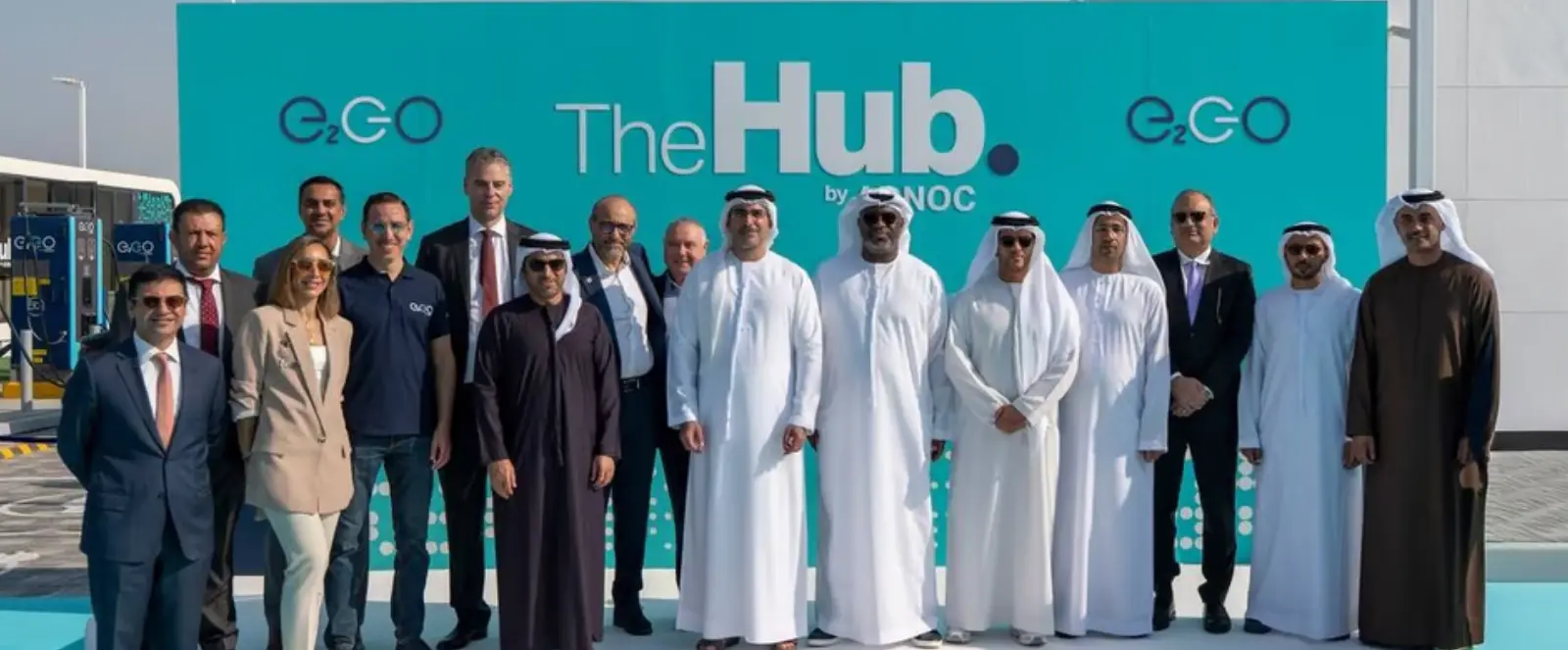
On January 12, 2026, ADNOC Distribution made public two things at once. First, it opened a major new superfast EV “Megahub” on the E11 between Abu Dhabi and Dubai. Second, it shared a highway charging roadmap that runs through the end of 2027.
Sounds like corporate talk, sure. But the details are practical. And the location choice is not random.
So here’s a clean breakdown, in plain language.
What was announced, and when it became public
This news was made public on January 12, 2026.
That’s the key date. Not “last week,” not “recently,” not “this month.” January 12.
The announcement covered:
- A new EV Megahub with 60 high-speed charging points
- A stated goal to roll out 20 highway EV charging hubs by the end of 2027
- A nearer milestone of 15 hubs expected by the end of 2026
- A wider UAE charging network target of up to 750 charging points by 2028, with more than 400 already installed at the time of the announcement
If you only remember one sentence, remember this: it’s not just one big station. It’s one big station plus a map for what comes next.
The EV Megahub: what it is and where it sits
The location is the whole point
The Megahub is located at Saih Shuaib on the E11 highway between Abu Dhabi and Dubai.
If you live in the UAE, you already get why that matters. The E11 is not a “nice-to-have” road. It’s one of the busiest corridors in the country. It connects two of the biggest cities. It carries commuters, business travel, airport runs, weekend trips, and everything in between.
Putting a large charging site there is a very direct move. It targets the main pain point: intercity driving.
The headline number: 60 charging points
Sixty is a lot. It’s the kind of number that changes the vibe at a site.
Most charging locations feel like a small corner of a parking lot. Two bays, maybe four. You pull up and hope nobody is there.
A 60-point site is different. It’s built for volume. That doesn’t mean there will never be queues. But it shifts the odds in your favor, especially on busy days.
Charging time claims, with a reality check
The public statement says the Megahub can charge “most EVs” from 0 to 80 percent in around 20 minutes.
That’s a useful benchmark. But let’s be honest about it.
Charging speed always depends on:
- Your car’s maximum charging rate
- Battery temperature
- How full the battery already is when you plug in
- How the station manages power across many chargers at once
- Ambient heat and how well your car handles it
So yes, it can be fast. Very fast for many cars. But you should treat “0 to 80 in 20 minutes” as “best case when conditions are right,” not a promise for every car, every time.
This isn’t just chargers. It’s also a “commuter hub” setup
ADNOC didn’t frame this site as “a charging lot.” It framed it as part of “The Hub by ADNOC” concept, and it described this one as commuter-first.
Here’s what’s different about that approach.
A bigger footprint, built like a stop you can actually use
The public info says the site footprint is about three times larger than a traditional service station. The idea is that you can do more than just plug in and stare at your phone.
That matters because charging time, even when fast, is still time. If you can grab food, use clean facilities, or sit somewhere comfortable, that time stops feeling like wasted time.
A coworking space, which is a smart touch
This part stood out: the Megahub site is described as the first of this concept to include a coworking space.
If you drive between Abu Dhabi and Dubai for work, you know how useful that can be. A quick charge becomes a chance to send emails, take a call, or finish a task without doing it from the driver’s seat like a stressed-out raccoon.
It’s a small detail. But it’s the kind of detail that shows someone thought about how people actually travel here.
The “electrified highway” roadmap: what it really means
Let’s translate the roadmap into normal language.
It does not mean every highway rest stop will suddenly turn into an EV-only lounge.
It means ADNOC Distribution plans to build out a network of highway charging hubs so you can do longer drives without planning your whole day around charging.
The targets that were made public
- 20 highway EV charging hubs by the end of 2027
- 15 of those expected by the end of 2026
- Coverage intended across “core UAE national highways”
That last phrase matters. It suggests they are focusing on the main routes first. The roads that carry the most people, most often.
So if you’re the kind of driver who does:
- Dubai to Abu Dhabi and back
- Dubai to Al Ain
- Abu Dhabi to Al Ain
- Dubai to Sharjah, Ajman, Umm Al Quwain, Ras Al Khaimah
- Dubai to Fujairah across the mountains
This plan is clearly aimed at making those trips feel normal in an EV.
Not brave. Not “for early adopters.” Normal.
Why this matters for EV drivers in the UAE (real examples)
Here’s the thing. A lot of EV owners don’t struggle in daily city driving. They struggle on the edge cases.
Case 1: The last-minute Abu Dhabi meeting
You’re in Dubai. You get called in for a meeting in Abu Dhabi. You didn’t plan it. You didn’t leave home with 90 percent because you weren’t thinking about it.
A large fast-charging hub on the E11 helps because it fits into the route you already take.
Case 2: Weekend drives that eat range
Beach trips. Desert drives. Visiting family in another emirate. You do longer runs, the AC is on, and highway speed is highway speed.
That’s where charging hubs matter more than “chargers somewhere in the city.”
Case 3: Ride-hailing and delivery drivers
These drivers live on uptime. They don’t have time for charging drama.
A large site with many charging points can reduce the risk of “I arrived and all chargers were taken.” It doesn’t erase it, but it helps.
The honest part: big hubs don’t solve everything
It’s tempting to see a 60-point site and think, “Done. Problem solved.”
Not quite.
Busy times are still busy times
If a lot of people start using the same hub at the same hours, queues can still happen. Think:
- Sunday evening return traffic
- Holiday weekends
- Big events in Abu Dhabi or Dubai
- End of day commuter rush
Scale helps, but it’s not magic.
Fast charging is hard on batteries if abused
Most EV makers recommend fast charging for trips, not as your only charging method every single day. Home charging is still the most comfortable way to live with an EV.
So if someone buys an EV with no home charging and relies on fast charging all the time, they may still feel annoyed, even with new hubs.
Charging speed drops at higher state of charge
Even on the best chargers, charging slows down as you approach full. That’s how batteries work.
So your trip planning should still look like:
- Arrive low-ish
- Charge to a practical level
- Move on
If you arrive at 60 percent and try to charge to 100 percent, you will be there a while. And you might irritate people waiting behind you. It happens.
How to use a highway charging hub without wasting time
This is the part that actually saves you minutes.
Arrive with the right battery level
If you can, arrive between about 10 percent and 20 percent. Not because it’s cool. Because charging is often quickest when the battery is lower, especially in the early part of the session.
Use your car’s navigation before you get there
Many EVs will pre-condition the battery for fast charging if you navigate to a charger using the built-in system. That can help charging speed, especially in heat.
Don’t chase 100 percent unless you have a reason
On highway trips, charging from 10 percent to 60 or 70 percent is usually the sweet spot for time. Going from 80 to 100 can feel painfully slow.
Have a backup plan anyway
Even with a big hub, keep one alternative location in mind. Not out of fear. Just basic travel sense.
What this signals about the UAE EV market
This announcement lines up with a bigger shift already happening.
EVs are no longer a niche product here. They’re becoming part of normal road life, especially in Abu Dhabi and Dubai.
The country has targets, and infrastructure has to match
The public statements around UAE policy include an ambition for EVs to represent a large share of vehicles by 2050. Whether that exact path is smooth or messy, it’s clear that infrastructure has to expand.
No one is going to buy an EV just because a target exists on paper. People buy when it feels convenient.
So building highway hubs is not a “nice PR move.” It’s a practical step if you want EV ownership to spread beyond city-only driving.
ADNOC’s network footprint gives it an advantage
ADNOC Distribution has a huge presence across the UAE with hundreds of stations and sites. That matters because charging networks are not just about hardware.
They are about:
- where you can place chargers
- how you maintain them
- how quickly you can add more
- whether the site is safe and easy to enter and exit
- what people can do while they charge
This is where established roadside operators can sometimes move faster than newer players.
Questions people should still ask (and watch over 2026 and 2027)
Here are the big “wait and see” points. These are fair questions, not negativity.
What will pricing look like over time?
Charging price matters. A lot.
If fast charging becomes expensive, drivers will still use it for trips, but they may complain more and plan more. If pricing stays reasonable, usage grows faster.
How consistent will uptime be?
A huge station looks great on day one. The real test is month six, month twelve, and year two.
People don’t care about announcements. They care about whether the charger works at 9:30 pm when they need it.
Where will the next highway hubs go?
The roadmap has targets. Drivers will want to know the actual locations as they get announced.
If the hubs land on the most useful routes, adoption is easier. If they land in awkward spots, people will still hesitate.