



%201.svg)

If you want to know whether EV tech is “ready” for the UAE, don’t look at a shiny new SUV on a showroom floor.
Look at buses.
Buses are the hard mode of electric driving. They run all day. They stop and go hundreds of times. They carry heavy loads. And in Dubai, they do it with serious air conditioning and brutal summer heat.
So when Dubai’s RTA starts putting electric buses into normal city routes at real scale, it’s not just a nice headline. It’s a signal that the ecosystem is moving from small pilots to real operations.
In January 2026, RTA confirmed the arrival of the first batch of 250 buses out of a 735-bus contract, including 40 electric buses that RTA described as the largest first-of-its-kind procurement in the UAE, with remaining deliveries expected to complete in 2026.
Let’s talk about what this rollout tells us about where EV fleets are going in the UAE, and what it means for charging, service capacity, and parts.
What Dubai actually rolled out (numbers and specs that matter)
RTA’s announcement includes details that are unusually useful for understanding the real-world plan.
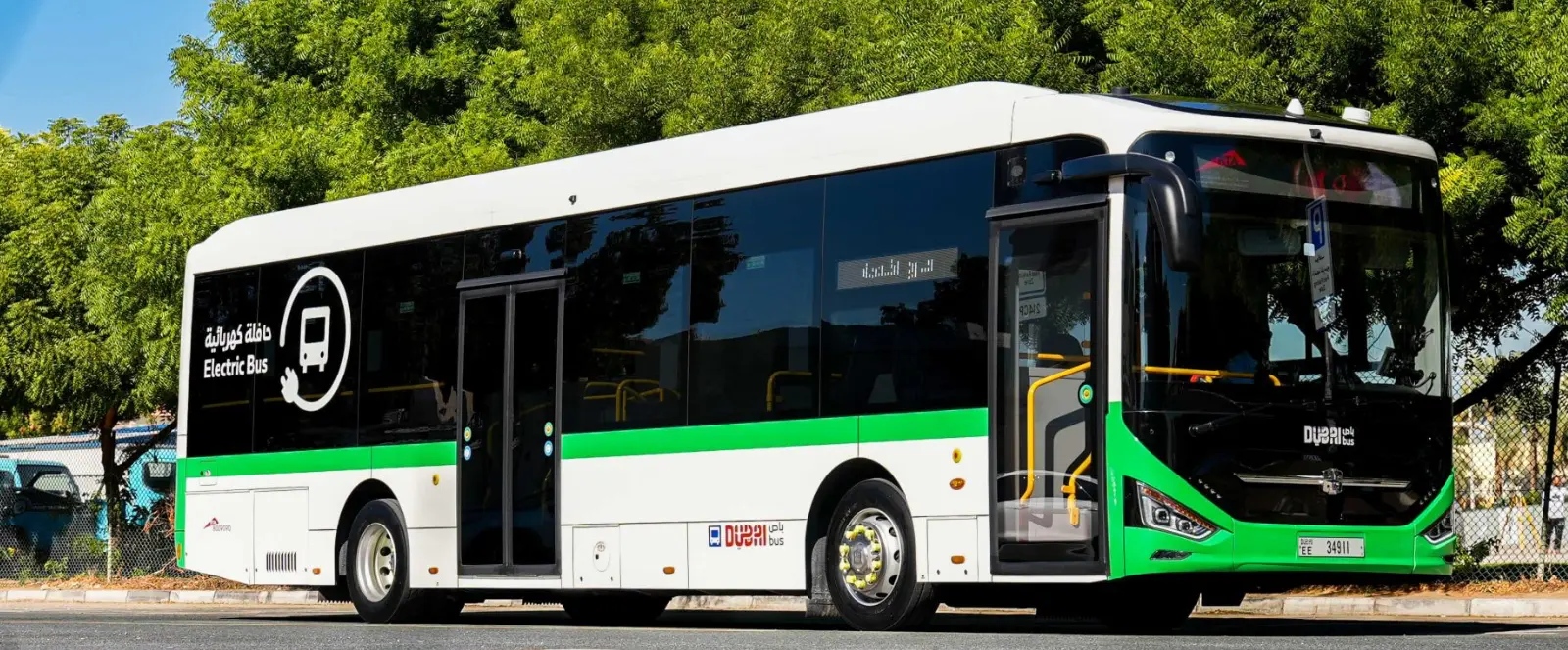
The electric bus model RTA highlighted is a Zhongtong bus, custom built for Dubai operating conditions. It’s listed with:
- Up to 280 km range on a single charge
- 434 kWh battery capacity
- Charging support via an ABB charger rated at 360 kW
- 12 meters long, carries 70 passengers
- A battery-cooling system suited to the UAE climate
- 3+ months of testing in Dubai, with reported positive results across propulsion stability, energy consumption, braking safety, air conditioning, and cooling performance
- Reported 95% driver and passenger satisfaction during trials
RTA also tied this to its longer-term direction: a strategy aiming to shift public transport buses to electric and hydrogen power by 2050 as part of its zero-emission public transport plan.
So, what does all this signal?
Signal 1: Electric buses mean the UAE is moving from “EVs as personal cars” to “EVs as infrastructure”
Personal EV ownership grows one driver at a time. Fleet electrification grows in bulk.
When a public operator like RTA commits to dozens of electric buses inside a large procurement plan, it forces the city to solve the problems that private owners can sometimes avoid.
Here’s the thing: if an EV owner has a bad charging day, it’s annoying.
If a fleet has a bad charging day, service stops. People complain. Schedules break. The operator gets pressure from all directions.
That pressure is useful because it forces the system to mature.
And it pushes investment into:
- reliable charging at depots
- maintenance training and procedures
- parts planning and inventory
- thermal management validation in real heat
In real life, it looks like this:
A private EV can get away with “charge whenever you find a spot.” A fleet can’t. Fleets need a charging plan that works every day, even on the worst day.
Signal 2: Charging is becoming a high-power, depot-first game for fleets
Most people imagine public EV growth as “more chargers at malls.”
Fleet electrification changes the picture.
For buses, the main question is usually not “where are the public chargers?” It’s “how do we charge 40 buses reliably without chaos?”
Here’s how it works
Most electric bus systems rely heavily on depot charging, meaning buses charge back at their home base, often overnight.
RTA’s public info points directly to depot capability because it highlights a 360 kW ABB charger supporting the bus.
A simple way to think about it is this:
- A single bus has a 434 kWh battery.
- If you wanted to add, say, 260 kWh (roughly 20% to 80%) in an ideal world, and you could charge at 360 kW, that is about 43 minutes (260 ÷ 360 = 0.72 hours).
- In reality, charging slows down near the top, and heat matters, so times vary.
Now scale it.
If 40 buses each need hundreds of kWh per day, that depot becomes a serious electrical site. You’re talking megawatts of potential load, and you don’t want all buses charging at full power at the same time.
That’s why bus charging normally includes load management, staged charging, and electrical upgrades at depots.
ABB’s public transit charging materials describe approaches like depot charging and opportunity charging setups, often with purpose-built infrastructure rather than “normal car chargers.”
What this means for the wider UAE charging ecosystem
When a city upgrades depots for bus charging, it builds capability that can spill over into:
- better grid readiness for future fleet depots (delivery vans, taxis, corporate fleets)
- more experienced installers and engineers
- improved standards for safety and reliability
- more pressure to streamline licensing and approvals for large charging sites
Even if you never ride an electric bus, you benefit from a city that knows how to deliver high-power charging reliably.
Signal 3: The UAE climate is the real test, and RTA is telling you what matters
In EV talk, people obsess over range.
Fleet operators obsess over thermal performance.
RTA’s announcement doesn’t just say “it’s electric.” It repeatedly points to cooling and air conditioning performance, and it says the bus uses an advanced battery-cooling system suited to the UAE climate.
This is not a random detail.
In the UAE, heat hits an EV in three ways:
- Battery cooling load goes up
- Cabin cooling load goes up
- Charging heat becomes harder to manage
RTA also said trials confirmed performance on routes with frequent stops and speed changes, including energy efficiency, brake responsiveness, and AC and cooling performance.
So the lesson is simple:
If an electric bus can’t cool itself well, it won’t be reliable.
And if it isn’t reliable, it won’t scale.
This is why EV fleet growth often pushes thermal system know-how faster than private EV growth does.
Signal 4: EV fleets push service capacity forward faster than the private market alone
EVs have fewer routine service items than petrol cars, but they demand different skills.
And buses amplify that demand because:
- they accumulate mileage quickly
- downtime has a bigger operational cost
- safety processes must be consistent across teams
RTA’s rollout also includes broader technology upgrades across the fleet such as driver behavior monitoring, passenger counting systems, and driver identity authentication.
This matters because the future of fleet maintenance is not just mechanical. It’s electrical plus software plus sensors.
Here’s the thing: when fleets grow, workshops need to become more “system-based” in how they diagnose issues.
In real life, it looks like this:
- A bus reports a cooling system fault code.
- That fault might be a pump, a valve, a sensor, a wiring issue, or a software logic issue.
- The right fix depends on proper diagnostics, not guessing.
Fleet operators tend to demand repeatable diagnosis. That raises the standard for everyone.
Signal 5: Parts planning becomes smarter when fleets commit
Parts delays are one of the most frustrating parts of EV ownership.
Fleet operators hate delays more than anyone.
When fleets commit to vehicles, they often push for:
- predictable supply of common parts
- local stockholding
- clearer support channels
- faster warranty processes
RTA’s 735-bus contract includes multiple manufacturers and bus types, not just electric buses.
That kind of large procurement tends to create “gravity” in the supply chain. Suppliers have a reason to stock parts locally because the demand is steady and large.
This can help if you are a private EV owner, especially if your car shares component families with fleet tech over time (cooling components, sensors, charging hardware standards, service tooling). It’s not guaranteed, but it’s one of the ways ecosystems mature.
The catch is brand diversity can also complicate parts, especially early on. More models can mean more unique parts, and workshops need time to build familiarity and stock.
Signal 6: Fleet electrification is shaping public policy and standards, not just vehicles
Public fleets force clarity.
When the government or a large operator is buying and operating electric vehicles at scale, you start seeing:
- clearer charging standards
- clearer safety expectations
- more formal licensing and regulation around charging infrastructure
- more structured data collection
Dubai has also been formalizing its charging ecosystem through frameworks and licensing approaches for charge point operators, which supports broader growth beyond a single operator’s network.
This is the less exciting side of EV growth, but it matters more than people think. Standards reduce friction, and friction is what makes EV ownership feel hard.
What private EV owners can learn from electric buses
You might be thinking, “Cool, but I drive a Tesla or a BYD, not a bus.”
Fair. But the bus rollout offers practical lessons that apply to normal cars in the UAE.
Lesson 1: Thermal health is battery health
RTA is highlighting cooling because cooling is what keeps the battery in its comfort zone.
For private owners, that translates to:
- don’t ignore A/C issues
- don’t ignore coolant warnings
- don’t treat “small overheating events” as harmless
- keep vents, radiators, and cooling paths clean and unobstructed
Lesson 2: Charging speed is a system, not a number
RTA’s bus uses high-power charging support, but the rollout is still designed around completing daily routes without returning to depots for recharging.
That tells you something: even with fast charging available, operational planning often tries to avoid unnecessary mid-day charging.
For a private owner, this can help if you’re struggling with public charger congestion:
- Charge at home or work when you can
- Use fast charging for real needs, not as your daily default
- Avoid back-to-back fast charging in peak heat when you have a choice
Lesson 3: Stop-start driving is normal, but it stresses different systems
Buses live in stop-start conditions, and RTA specifically calls out brake performance and stability in frequent stops and speed variations.
In cars, stop-start traffic can stress:
- cooling systems
- A/C compressors
- suspension and bushings
- brakes that do not get used much because regen does most slowing
If you only do one thing, do this: don’t assume regen means your brakes are “maintenance-free.” They can still corrode, seize, squeal, or wear unevenly.
The bigger picture: why buses are a strong signal for the GCC
Electric buses are not a “nice-to-have” test. They are proof that the region is building operational confidence in:
- high-duty-cycle EVs
- high-power charging infrastructure
- heat-ready thermal systems
- training and safety procedures
- data-driven maintenance
Dubai’s rollout includes hard specs and hard testing details, which is exactly what you want to see if you care about whether this is real or just a PR story.
And it fits the broader direction across the region: cities and governments are treating EV growth as infrastructure, not just consumer choice.
A quick checklist if you’re buying an EV in the UAE this year
This is the practical part. If fleet electrification tells us anything, it’s that the basics matter more than the hype.
Charging reality
- Where will you charge most days?
- Do you have a backup plan if your usual charger is busy?
- Do you understand the difference between AC and DC charging for your routine?
Thermal reality
- Is the car known to handle heat well?
- Does the A/C perform strongly in traffic, not just on the highway?
- Does the car have a clear service path for cooling system parts?
Service reality
- Who will diagnose it if it throws an error?
- Can you get support without waiting weeks?
- Are parts commonly available in the UAE for your model?
This can help if you want an EV that feels easy to live with, not one that feels like a constant project.
Bottom line
Dubai’s electric bus rollout is a strong signal because buses are unforgiving.
When a fleet operator says, “We tested it for months, we validated cooling and braking performance, and we’re deploying it on city routes,” it tells you the UAE is building the kind of EV ecosystem that supports reliability, not just adoption.
That won’t make every EV problem disappear overnight. But it does mean the direction is clear: more fleets, more charging build-out, more service capability, and better parts planning.
And that’s good news for anyone who wants to own an EV in the GCC without feeling like they’re constantly improvising.

.webp)